Citrix: EventID 110


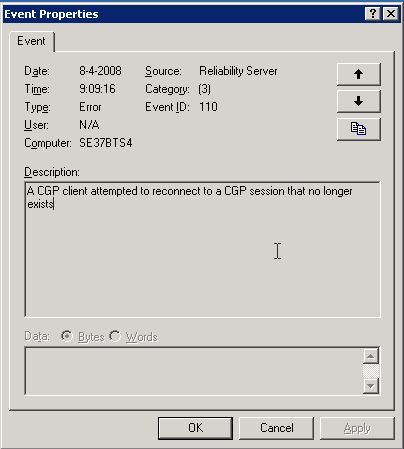
De volgende melding kun je terug vinden op je Citrix server. Deze melding treed op zodra je hotfix rollup pack 1 hebt geïnstalleerd.

image

Oplossing / Workarround

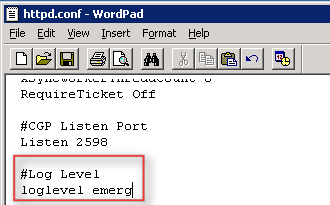
Open het bestand C:\Program Files\Citrix\XTE\conf\httpd.conf in Wordpad.

Voeg daarna de volgende text toe:

#Log Level

loglevel emerg

image 

Als laatste herstart je de XTE service. Dit kun je via Start – Run – Services.msc doen of via het commandprompt:

net stop “Citrix XTE Server” en net start “Citrix XTE Server”

Meer informatie over deze issue vind je hier: CTX114680

VMware: Microsoft NLB and VMware ESX 3.x.x


Mocht je gaan werken met Microsoft NLB binnen een VMware ESX 3.x.x omgeving, dan is handig om de volgende twee artikelen te lezen:

Ik ben bezig met een test opstelling voor een Citrix Webinterface NLB opstelling. Zodra ik dit klaar heb zal ik mijn ervaringen posten.


Petje bedankt voor het posten in het vmug forum.

How To: Manually Assigning a MAC Address to a VM


Ga Control PanelNetwork Connections Properties van je network connection. Daarna ga je naar het tabblad Advanced  NetworkAddress hier kun je een MAC address invoeren via een vaste waarde van bv. 123456789E12.

Je kunt een bestaand MAC address gebruiken van een fysieke netwerkkaart welke je niet meer gebruikt en toch weg doet! Je kunt ook een MAC address genereren via een tool generate_mac_addresses_for_vmware.

image

Je kunt het ook via een parameter in het vmx bestand doen. Hoe dit werkt lees je hier: http://www.vmware.com/support of http://www.vmware.com/support/

Jurgen bedankt voor de tip!!

How To: Disable the Information bar for some processes.


De volgende bar kan opkomen als je een html file opent vanaf je lokale hardeschijf.

image

Dit kun je via de volgende registry file aanpassen:

Windows Registry Editor Version 5.00
[HKEY_LOCAL_MACHINESOFTWAREMicrosoftInternet ExplorerMainFeatureControlFEATURE_LOCALMACHINE_LOCKDOWN]
@=””
“explorer.exe”=dword:00000000
“msimn.exe”=dword:00000000
“iexplore.exe”=dword:00000000
“wmplayer.exe”=dword:00000000

Mocht je het bovenstaande verhaal weer willen terugdraaien, dan voer je de volgende key in:

Windows Registry Editor Version 5.00
[HKEY_LOCAL_MACHINESOFTWAREMicrosoftInternet ExplorerMainFeatureControlFEATURE_LOCALMACHINE_LOCKDOWN]
@=””
“explorer.exe”=dword:00000001
“msimn.exe”=dword:00000001
“iexplore.exe”=dword:00000001
“wmplayer.exe”=dword:00000001


Bron: http://forums.techguy.org/tech-tips-tricks/365594-disable-ie-information-bar.html

Microsoft: Well-known security identifiers in Windows operating systems


Het volgende document kan heel handig zijn bij het troubleshooten.

A security identifier (SID) is a unique value of variable length that is used to identify a security principal or security group in Windows operating systems. Well-known SIDs are a group of SIDs that identify generic users or generic groups. Their values remain constant across all operating systems.
This information is useful for troubleshooting issues involving security. It is also useful for potential display problems that may be seen in the ACL editor. A SID may be displayed in the ACL editor instead of the user or group name.

KB243330

Performance Monitoring and Context Switches


In deze post plaats ik een aantal links over performance monitoring en context switches.

Microsoft

Citrix

Overige sites

De volgende quote komt uit het document van de Intel site.

Counter (Parent Object)
Recommended Range

% CPU Time (System)
0-90% ( > 90% indicates potential processor bottleneck; may also indicate thread contention problem; investigate Context Switches/sec and System Calls/sec for potential thread issues)

% Privileged Time (System)
0-40% ( > 40% indicates excessive system activity; correlate with System Calls/sec)

Context Switches/sec (System)
0-10,000 ( > 10,000 may indicate too many threads contending for resources; correlate with System Calls/sec and threads counter in Windows Task Manager to identify process responsible)

File Control Operations/sec (System)
Ratio dependent (The combined rate of file system operations that are neither reads nor writes [file control/manipulation only, non-data related]. Inverse of File Data Operations/sec)

File Data Operations/sec (System)
Ratio dependent (Combined rate of all read/write operations for all logical drives. Inverse of File Control Operations/sec)

System Calls/sec (System)
0-20,000 ( > 20,000 indicates potentially excessive Windows system activity; correlate with Context Switches/sec and threads counter in Windows Task Manager to identify process responsible)

Interrupts/sec (System)
0-5000 (> 5000 indicates possible excessive hardware interrupts; justification is dependent on device activity)

Pages/sec (Memory)
0-200 ( > 200 warrants investigation into memory subsystem; define reads (pages in) versus writes (pages out); check for proper paging file and resident disk configuration; May indicate application memory allocation problems, heap management issues)

Average Disk Queue Length (Logical Disk)
0-2 ( > 2 indicates potential disk I/O bottleneck due to I/O subsystem request queue growing; correlate with Average Disk sec/Transfer)

Average Disk sec/Transfer (Logical Disk)
0-.020 ( > .020 seconds indicates excessive request transfer latency and potential disk I/O bottleneck; define reads/sec versus writes/sec; correlate with Average Disk Queue Length)

Bytes Total/sec (Network Interface)
Depends upon interface type (10baseT, 100baseT) A potential network I/O bottleneck exists when throughput approaches theoretical maximum for interface type. (For example, 10baseT theoretical maximum = 10 x 1,000,000 bits = 100 Mbits/sec divided by 8 = 12.5 Mbytes/sec)

Packets/sec (Network Interface)
Depends upon interface type (10baseT, 100baseT)

Script: Install Printer Drivers On TS/Citrix Servers


Aleks van http://www.virtualistic.nl/ heeft een script geschreven voor het installeren van Printer drivers op een Terminal / Citrix server. Ik was de gelukkige betá tester (zonder problemen) en alles werkte out of the box.

Hieronder een quote van de website van Aleks:

Prerequisites:
– You have to be able to install printdrivers (duh!)
– You have to be able to connect to your printerserver (test this through typing \\yourprintserver you should see your shared printers)
What is inside the zip file?
– The script of course!
– Addprinters.txt this is the input file for the script. Place your printers in this .txt file (eg: \\yourprintserver\printer1)
The default location of the addprinters.txt is C:\ You can change this but make sure you edit the script to reflect the new location.

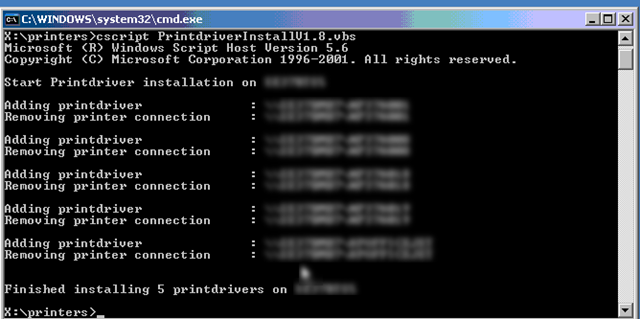
Zodra je het Addprinters.txt hebt gevuld, start je het script en dan verschijnt het onderstaande scherm.

PrinterDriver_Script

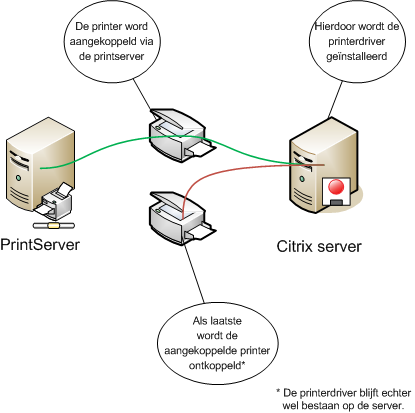
Nu ben je natuurlijk benieuwd wat het script gedaan heeft. Dat laat ik zien in de onderstaande tekening:

printerscript

Meer informatie en de download vindt je hier: http://www.virtualistic.nl/

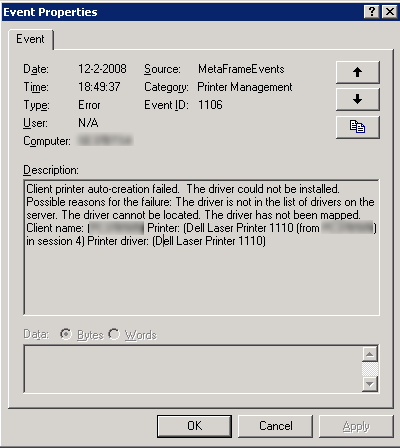
Citrix: EventID 1106


De volgende melding kun je tegenkomen in je application log op een Citrix Server.

eventid1106

Dit kun je oplossen door de volgende registry key te importeren:

Windows Registry Editor Version 5.00

[HKEY_LOCAL_MACHINE\SOFTWARE\Citrix\Print]
“DefaultPrnFlags”=dword:80000000

Deze oplossing geld alleen voor Presentation Server 4 en hoger.

Voor meer informatie zie: CTX488760

VBScript: Create a Domain Local Security Group


Voor een nieuwe folderstructuur op ons netwerk, moest ik een groot aantal nieuwe Domain Local Security Groups aanmaken. Dit doe je natuurlijk niet met de hand maar  via een script. Ik wist toevallig dat Bouke Groenescheij van www.jume.nl hier al een script voor had gemaak. Het script kun je hier vinden: http://www.jume.nl/index.php?option=com_content&task=view&id=73&Itemid=1

Zijn script heb ik een klein beetje aangepast zodat het Domain Local Security Groups aanmaakt i.p.v Global Security Groups.

Ik heb de volgende regels eruit gehaald:

Const ADS_GROUP_TYPE_DOMAIN_LOCAL_GROUP = 4
Const ADS_GROUP_TYPE_GLOBAL_GROUP       = 2
Const ADS_GROUP_TYPE_LOCAL_GROUP        = 4
Const ADS_GROUP_TYPE_SECURITY_ENABLED   = -2147483648
Const ADS_GROUP_TYPE_UNIVERSAL_GROUP    = 8

en vervangen voor:

Const ADS_GROUP_TYPE_GLOBAL_GROUP = &h4
Const ADS_GROUP_TYPE_SECURITY_ENABLED = &h80000000

Meer informatie over de Const ADS_GROUP_TYPE vindt je in dit document: 63_65_scripting_guy.pdf

Daarna moet je nog een regel aanpassen in het script:

‘ ################################################################
‘ CreateGroups.vbs – Create a lot of groups based on a text file
‘ Written by Bouke Groenescheij – Jume B.V.: http://www.jume.nl
‘ Version 1.0
‘ ################################################################

‘ You will need to supply this info:
strGroupParentDN = “ou=Bulkimport,dc=ctx45,dc=lab”

In het dik gedrukte gedeelte vul je de ou naam in en je domain. bijvoorbeel ctx45.lab

Nadat je dit gedaan hebt, moet je nog een textfile aanmaken. In deze tekstfile plaats je de naam van de groep en de description. Dit ziet er als volgt uit:

ctx_test1,testgroep1
ctx_test2,testgroep2
ctx_test3,testgroep3
ctx_test4,testgroep4
ctx_test5,testgroep5
ctx_test6,testgroep6
ctx_test7,testgroep7
ctx_test8,testgroep8
ctx_test9,testgroep9

Als laatste voer je het script als volgt uit:

cscript CreateGroups.vbs groups.txt

binnen enkele seconden zijn alle groepen aangemaakt.

Bouke bedankt voor het delen van dit handige script!

Error: RTHDCPL.EXE


Na het opnieuw installeren van mijn Windows XP installatie verscheen na de reboot de volgende melding.

RTHDCPL_error

Zodra je security update KB925902 hebt geïnstalleerd kan de bovenstaande error optreden.

Install this update to resolve an issue where certain third-party applications may not start, and you receive an error message: “Illegal System DLL Relocation” after you install security update KB925902 (MS07-017). After you install this item, you may have to restart your computer.

De hotfix kun je hier downloaden: KB935448