Virtual Infrastructure products: features comparison


Ik was al een tijdje aan het zoeken naar een goede features comparison sheet. Ik zat er zelfs al aan te denken om er zelf een te maken tot dat Aleks (virtualistic.nl) me de volgende site liet zien: http://www.it20.info/

Disclosures:

  • I have limited the scope to x86 virtualization solutions
  • Virtualization is such a broad topic that I have decided to limit this table to hardware virtualization only solutions. The only exceptions as of today are “SW Virtuozzo” and “Solaris Containers” which do not implement hw virtualization but rather OS virtualization. For a description of these various virtualization tehcnologies check this article.
  • I have limited the solutions and the ISV to what I personally believe to be those that currently matter for the commercial/enterprise customers.
  • To shape/structure and fill this table I have collected feedbacks from various communities and other tables I came across in the last few months (thanks to Andreas Groth for his inputs). I am trying to maintain this page for the sake of the community … not to get credit for a work that others have been doing and I am only integrating here.
  • It’s proving to be very difficult to rate thorugh a simple yes/no table the value of a solution over the other. This is becoming even more challanging since most ISV’s are pushing into the value-add features rather than the pure hypervisor …
  • …. but since so many people are looking for such a table I decided to try ….
  • If you are one one the ISV’s mentioned below feel free to send me feedbacks and suggestions to the e-mail address above.
  • Some of the info in the tables are facts. Other info are opinion of the author and as such should be treated.

Structure of the Comparison:

  • High-level info and general market scenario (this will position the offering in the market)
  • Host/Hypervisor specific information/characteristics (this will high-light the hypervisor features)
  • Virtual Machines specific information/characteristics (this will high-light the potential virtual environments characteristics)
  • Infrastructure Management specific information/characteristics (this will enlarge the scope to the out-of-the box infrastruxture management features)

De comparison sheet kun je hier bekijken: http://www.it20.info/misc/virtualizationscomparison.htm

Thanks Aleks voor de link!

VMware: Installing VirtualCenter 2.5 Update 2


Alvorens je aan de slag gaat met het upgraden van je omgeving, download en lees eerst de vi3_35_25_u2_upgrade_guide.pdf

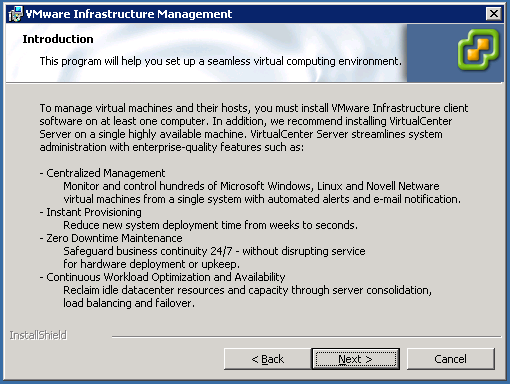
Zodra je klaar bent met lezen start je de autorun.exe vanaf de VC_CD.

image

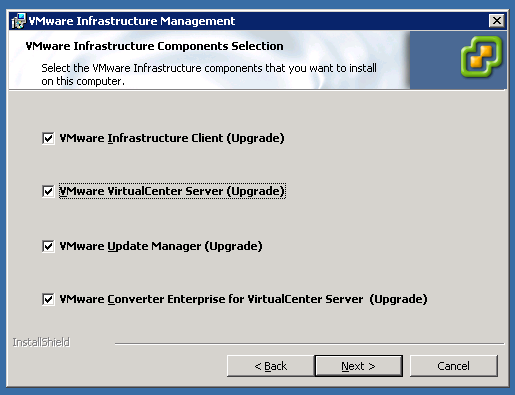
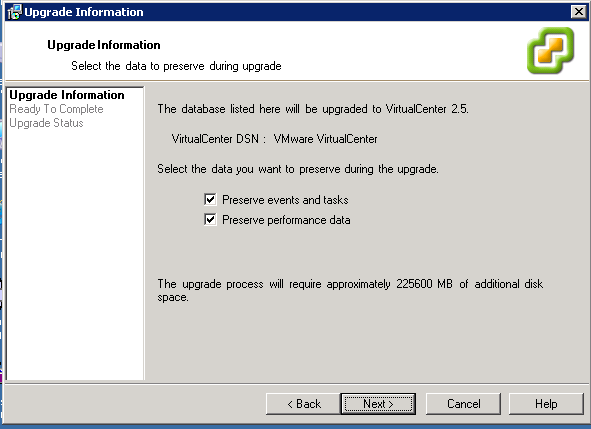
Vink je alles aan wat je wilt upgraden.

image 

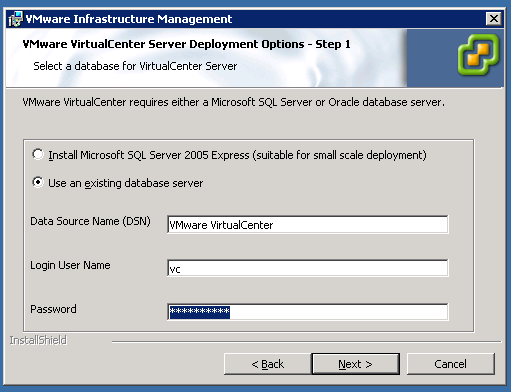
Geef de database settings op

image 

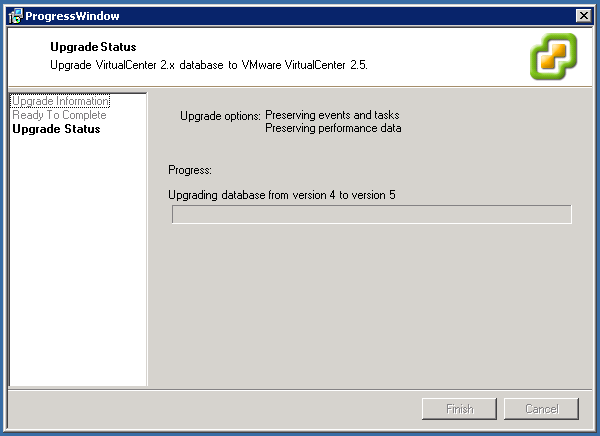
De Database wordt later bijgewerkt van Versie 4 naar Versie 5.

image

Even een waarschuwing tussen door. De agent draait gewoon op mijn SQL server dus waarom dit is weet ik niet.

image

De volgende melding moet je wel even serieus nemen.

image

In vi3_35_25_u2_upgrade_guide.pdf staat het volgende om de bovenstaande melding op te lossen.

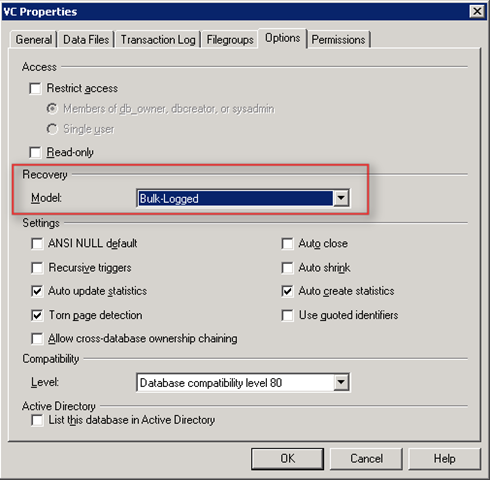
If you are upgrading a SQL database, you must first enable bulk logging in the
database.
a Open SQL Server Enterprise Manager.
b Right‐click the database and click Properties > Options > Recovery Mode.
c Select Bulk‐logged.

Zet het Recovery Model in op Bulk-Logged.

image

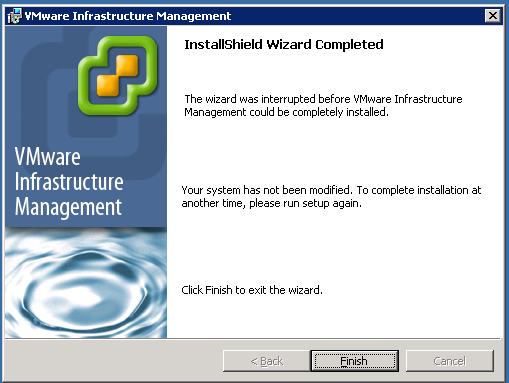
Hmm. En toen klapte de installatie eruit.

image

Ik kon nog niks vinden op google, over mogelijke oorzaken en oplossingen. De setup heb ik heb vervolgens in delen, met het handje gedaan.

  1. <VC25U2_CD>\vpx\VMware-licenseserver.exe
  2. <VC25U2_CD>\vpx\VMware VirtualCenter Server.msi

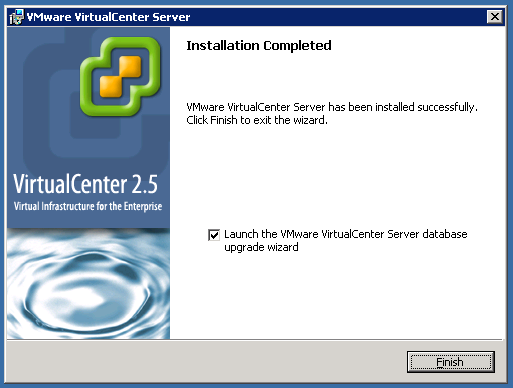
    Na de installatie van VirtualCenter server moet de database worden bijgewerkt:

  3. image

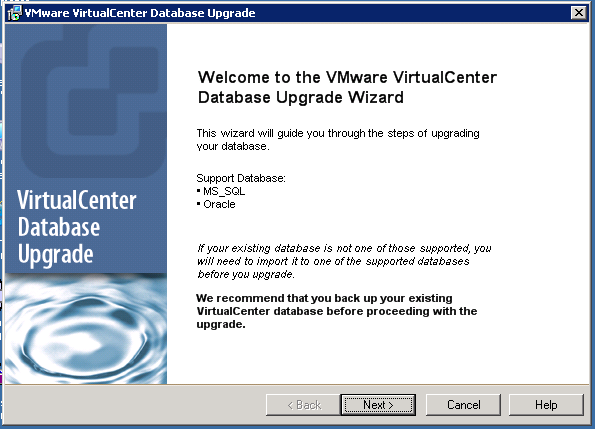
    De wizard word gestart

    image

    Ik heb hier de standaard waarden laten staan.

    image

    De database wordt bijgewerkt naar versie 5.

    image

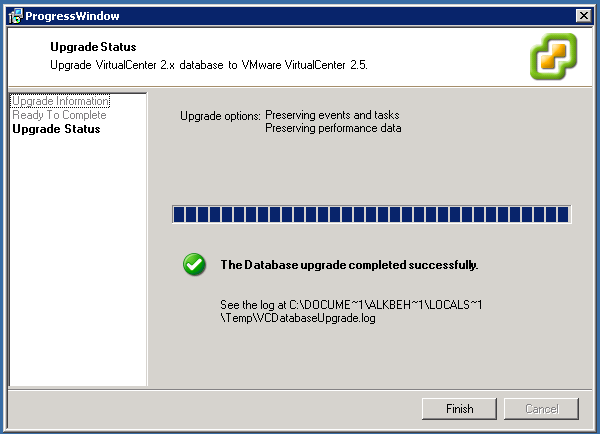
    De upgrade is goed gegaan.

    image

  4. <VC25U2_CD>\vpx\VMware-viclient.exe
  5. <VC25U2_CD>\updateManager\VMware-UpdateManager.exe
  6. <VC25U2_CD>\updateManager\VMware-UMClient.exe
  7. <VC25U2_CD>\updateManager\VMware-UMGuestAgent.exe
  8. <VC25U2_CD>\converter\VMware-Converter.exe

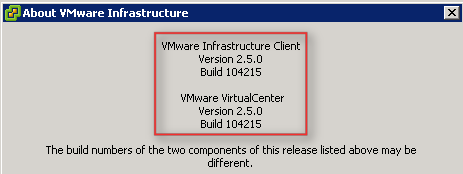
En alles is weer bijgewerkt naar de laatste builds.

image

VMware: Update 2 for ESX 3.5, ESX3i and VC2.5 released


VMware ESX 3.5 Update 2

Latest Version: 3.5 Update 2 | 7/25/2008 | Build: 103908 | Release Notes | Download

VMware ESXi 3.5 Installable Update 2

Latest Version: 3.5 Update 2 | 7/25/2008 | Build: 103909 | Release Notes | Download

VMware VirtualCenter 2.5 Update 2

Latest Version: 2.5 Update 2 | 7/25/2008 | Build: 104263 | Release Notes | Download

VMware Consolidated Backup 1.5

Latest Version: 1.5 | 7/25/2008 | Build: 102898 | Release Notes | Download

Tool: Tripwire Config Check for ESX 3.0 and ESX 3.5


image

Download de tool hier: http://www.tripwire.com/configcheck/configcheckdownload.cfm#download

Daarna pak je de zip file uit.

image

Mocht je onder Vista werken zoals ik, dan moet je de configcheck.bat starten met Administrator rechten.

Even de license agreement accepteren.

image

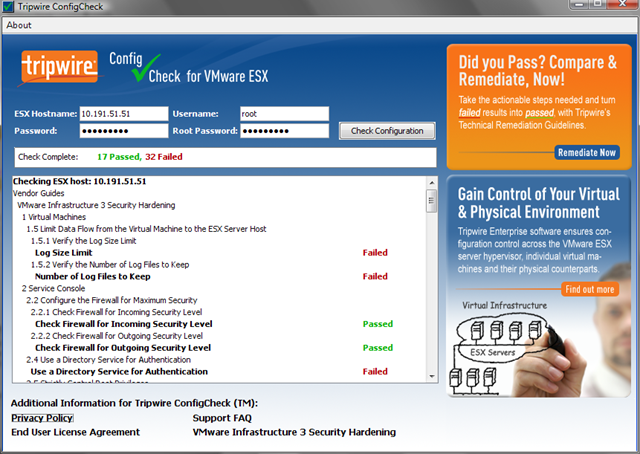
Nu kun je de esx host opvoeren en op check configuration klikken.

image

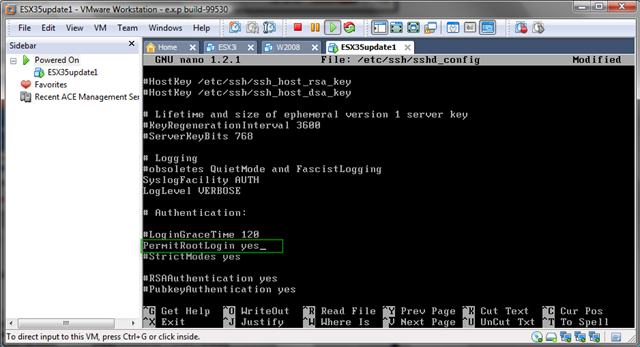
Ik heb deze test gedaan op een ESX 3,5 VM die net was geïnstalleerd. Ik had root access voor ssh nog niet aangezet en kreeg daardoor de volgende foutmelding.

image 

Gelijk even PermitRootLogin op Yes gezet

image

en /etc/init.d/sshd restart uitgevoerd.

Nu kon de test uitgevoerd worden.

image

Nadat de test klaar is kun je via de onderstaande link de Remediation Guide aanvragen.

http://www.tripwire.com/configcheck/tw_remediation_guide.cfm?pg=ccrm

VMware: ESX3i for free


virtualization.info has learned some additional details about the move:

  • VI 3.5 and ESX 3i will continue to share a the large majority of the code base (so there will be an ESX 3i Update 2). There will be no delays on the release of both products.
  • ESX 3i will continue to have the same features that has today, without additional limitations
  • ESX 3i will continue to have the same APIs, allowing anybody to develop free or commercial alternatives to VirtualCenter (despite some features like VMotion cannot be replicated because of the VMware SDK limitations).
  • VMware will not require the purchase of any software & support subscription to access the product. Customer will be able to get the code without any restriction.
  • The customers that purchased the current version of ESX 3i directly from the VMware online store will be eligible for a rebate.
  • The ESX version that includes the Console Operating System (COS) will not be faded out (at least in the short timeframe). Most VMware customers are currently using that version and the company will support them for a long time.
  • VMware Server will not be faded out (as many could suppose). The company still sees the product as a valuable proposition for a different kind of audience.


Lees de rest van het artikel hier: http://www.virtualization.info

VMware: Citrix on VMware Recommendations


Sven Huisman heeft weer een goede post geplaastst op zijn weblog.

Verron Martina from VMware dropped me an e-mail with a lot of recommendations for running Citrix in a VI3.x environment. These recommendations come from other system engineers from VMware working in the field. Thanks Verron, for sharing this.

Technical Recommendations:

  • I used the ballooning driver. Some Citrix forums will tell you not to use it but for us the ballooning driver made a complete difference.
  • Start by using only one vCPU per VM and if possible use affinity to make sure that the VM is not running on the same core as the console or another VM.
  • The sweet spot we found was to assign only 2GB to the VM and something between 30 and 40 users per VM.
  • Our target was not to beat a physical CPS server with a single VM but get more aggregated users using 2 or 3 VMs (depending on the number of cores available) with no more than 40 users per VM. Do not over commit the cores as that will lose advantage.
  • The final target for us was to demonstrate that the VMs running simultaneously on the same physical server can get a higher number of users (between 70 and 90% more) than a normal CPS installed on the same HW while user experience (keyboard-screen response times, login times, app launch times, etc) are very similar.
  • Some times we have to be patient and wait a few minutes for the VM to get steady, then the magic shows up and the VMs will surpass the physical server regarding load tolerance.
  • Regarding login times, the VM can show longer times; however, once the user is in, the VMs will look fast. Check than DNS servers are not getting messy as this is commonly the problem with long login times.
  • Make sure that the network interfaces are using fixed speed when connecting to the network, do not leave auto negotiated speeds. The best is to use 1000 mbps FULL DUPLEX. :-s
  • Use one virtual disk for Windows and CPS and a different virtual disk for Windows paging of the same VM.
  • When installing VMware tools use a custom installation and remove the shared folder feature. This is very important as Citrix seems not to like that and it is a useless feature on ESX as it’s meant for Workstation.

  • Follow VMware’s best practices for performance tuning on ESX (http://www.vmware.com/pdf/vi_performance_tuning.pdf)
  • Build your template Citrix virtual machine from scratch (don’t convert an existing physical server).
  • Use a single virtual CPU for the template vm
  • This will allow the Windows operating system in the guest to use a uni-processor HAL, as opposed to a SMP HAL, streamlining the guest operating system.
  • Configure the template vm for 2-4 GB RAM..
  • Configure separate virtual disks (VMDK files) for the operating system and the pagefile.
  • Ensure you align the NTFS partition in the VMDK prior to the Windows installation in the guest (at Netapp – http://media.netapp.com/documents/tr-3593.pdf;  at VMware – http://www.vmware.com/vmtn/resources/608).
  • Use a 64-bit Windows installation. :-s
  • Have an understanding of what an ‘acceptable’ threshold of users will be… Some customers see an increase in the number of users per Citrix instance when virtualized, some see fewer.  You should go into it with the expectation that you may get fewer users, as well as what you would like to see (ie 80% of physical or better?  70%?).


Bear in mind that even if you get fewer users per vm than in a physical environment, there are many other benefits to using virtualized Citrix servers:

Deployment:

  • One of the things many Citrix shops struggle with is their deployment process – how do we maintain an up-to-date image for the farm that incorporates the required applications and accommodates the hardware in question… rolling out Windows, including updates and patches, and the Citrix software (though this could be handled by Citrix Installation Manager).  Either way, you are maintaining server images somewhere  either through the use of a complicated installation script, or through imaging software such as Ghost.
  • Deploying a virtual machine through the use of templates is far quicker and more efficient than any other physical imaging process you might have used.  VMs can be deployed in a matter of minutes using templates.  The templates themselves can be created from existing virtual machines, and can be copied and used with VMware snapshots or SAN/NAS snapshots, giving you the ability to easily maintain a library of templates for different types of operating systems, applications, etc.

Disaster recovery:

  • Setting up a Citrix farm to failover to another site requires a large investment in hardware, and man-hours to configure the remote site to handle all the applications necessary.  Furthermore, the hardware in the remote site has to be of the same type as the primary, or your deployment strategy has to take hardware differences into account.
  • Using virtual machines, all you need to do to enable a DR site is have a copy of the required virtual machines in the remote location – hence you only need to set up the farm once, and maintain a copy of it in the remote location.  Spinning up your DR or business continuity site is a matter of ‘powering up’ the virtual machines.  VMware Site Recovery Manager may even help automate that process.

Stability:

  • Since the citrix system is accessed by users like a PC on a regular basis, a Citrix server is more prone to failure than a regular server (though, with proper maintenance, hopefully less prone than a desktop).  Server outages mean lost productivity for your users, and a significant effort in troubleshooting the problem, since Terminal Services is a good deal more complicated than a regular server.
  • To properly design for the outages we know we will have, you have to have extra capacity in the farm to handle the overflow users when one of the servers is down.  This is true for both planned and unplanned downtime.
  • VMware ESX has been recognized in the industry as one of the most stable platforms to be introduced… ever.  This means fewer outages due to host failures.  Also, since we standardize and virtualize the hardware of the guest operating systems, this holds true across different hosts, enabling your virtual machines to run across hosts from different manufacturers and chipsets.
  • See http://redmondmag.com/features/article.asp?EditorialsID=2400

Application Deployment:

  • Many Citrix shops do a good deal of work maintaining multiple images – deploying applications in ‘stovepipe’ configurations…  that is to say, multiple small groups of Citrix servers, each dedicated to a specific set of applications.  Frequently, this is due to largely due to application incompatibility.  However, it results in the Citrix admin being required to maintain several different images for the Citrix farm.
  • Even if the shop has standardized on a single Citrix image, they will not be using the company’s standard application deployment methodology…  Terminal Services is too funky with regards to application deployment, and requires much handholding.  Most Citrix shops has compeletely separate processes for packaging applications for a PC versus a Citrix server.
  • VMware ThinApp (http://www.thinstall.com) can be used to image your applications separately from the Citrix image… In fact, an application that has been packaged with ThinApp on Windows 2003 will work on Terminal Services, Citrix, Windows XP, and Vista, eliminating the need to package that application for the different platforms.  Furthermore, ThinApp includes a ‘sandbox’ to prevent applications from conflicting with each other.  You simply place the packaged application on a file share on the network, accessible to the Citrix servers (or PCs, or both), and you are done.  Your users simply execute the application from the shared directory, and they are off and running.  This results in a win-win for the customer – the ability to package an application once, and use it for either a PC environment or a Citrix environment.

Bron: http://virtualfuture.info/2008/07/citrix-on-vi3x-recommendations/

Building a OVF Repository with IIS 7.0


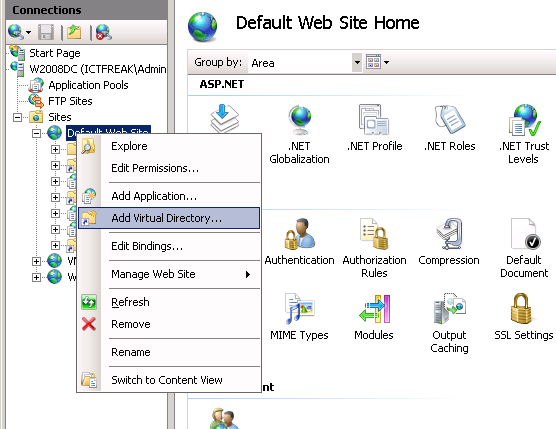
open de IIS management Console via Start – Run – inetmgr daarna voeg je een nieuwe Virtual Directory toe.

OVF_IIS7_1

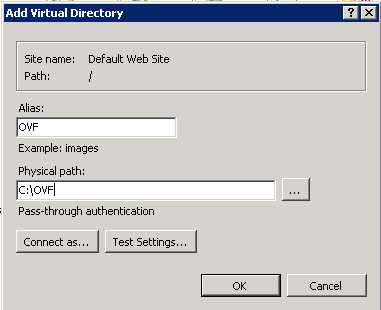
In mijn geval heb ik deze OVF genoemd en geeft het pad op naar de directory.

OVF_IIS7_2

Daarna moet je Directory Browsing inschakelen, anders gaat het helaas niet werken.

OVF_IIS7_3

Je kunt nog wat logging inschakelen.

OVF_IIS7_4

Als laatste moeten er nog een drietal MIME types worden toegevoegd:

  • .mf application/vmware
  • .ovf application/vmware
  • .vmdk application/vmware

OVF_IIS7_5

Vanaf nu kun je via de import wizard van VMware Workstation 6.5 beta 2 en VI 3.5 de appliances direct importeren d.m.v. een url die naar je OVF repository. Bijvoorbeeld http://iisserver/ovf/appliance.ovf