CentOS: How To Create a Local VMware Repository


image_thumb1[1] image_thumb[1]

The first step is to configure the repository server. Before you can start, you have to install the createrepo package. Just run the following command:

yum install createrepo

If you didn’t already, also install Apache on the Server that’s hosting the repository.

Let’s create a folder structure so we can place the rpm’s on the server. In case you want create a repository for 32 bit and 64 bit CentOS. You have to create a i386 and a x86_64 directory.

i368:

/var/www/html/repo/centos/5/i386/vmware

Upload your rpm files to the vmware directory and run the createrepo command:

createrepo /var/www/html/repo/centos/5/i386/vmware/

x86_x64

/var/www/html/repo/repo/centos/5/x86_64/vmware

Upload your rpm files to the vmware directory and run the createrepo command:

createrepo /var/www/html/repo/centos/5/x86_64/vmware/

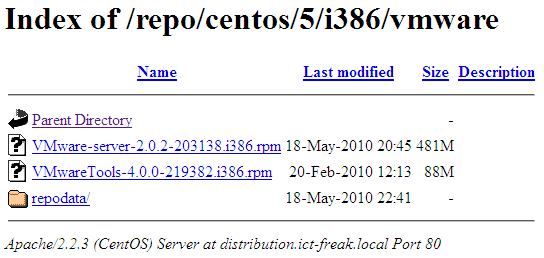
The next step is to test the repository. Just open your favorite web browser and browse to the url. In my case this is: http://distribution.ict-freak.local/repo/centos/5/i386/vmware.

image

If this works, your local vmware repository is ready for action. But first we need to add the repository on the client side.

Open the following file in your favorite text editor

/etc/yum.repos.d/vmware_local.repo

Add the following lines and edit the baseurl so it will match your environment.

[vmware_local]
name=Uniserver CentOS-$releasever-$basearch
baseurl=http://distribution.ict-freak.local/repo/centos/$releasever/$basearch/vmware/
gpgcheck=0
enabled=1

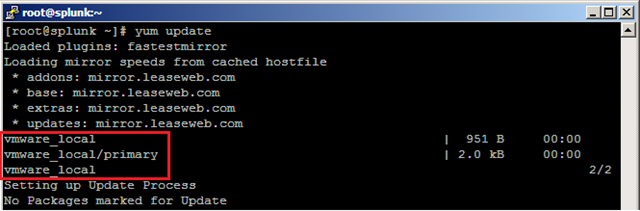
Save the vmware_local.repo file and run the yum update command.

image

Now you’re ready to install packages from the vmware_local repository. Let’s install VMware server 2.0.2-203138 by running the following command:

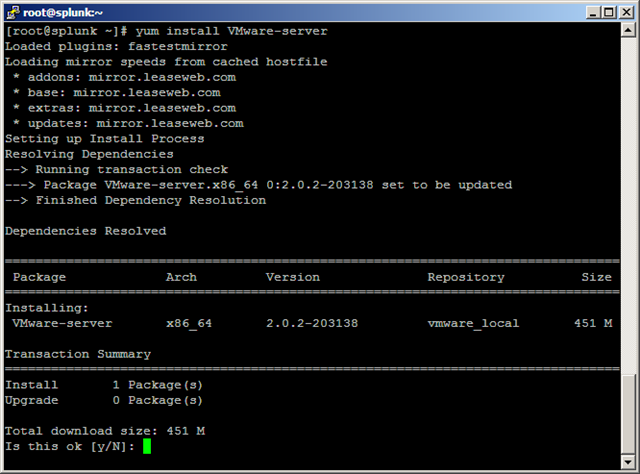
yum install VMware-server

The install process will start:

image

When you also upload the VMware Tools rpm file, you can install or update the package with the following commands:

Install:

yum install VMwareTools

Update:

yum update VMwareTools

When you need to upgrade de VMware Tools, the only thing you have to do is upload the new rpm file and run the yum update command. The finals step is to run the vmware-config-tools.pl script. But this step can be replaced by the check-vmware-tools script. More info about this script can be found here: http://bit.ly/97fpcD

PowerCLI: Script to Schedule Memory and or vCPU up/downgrade


After creating the Restart-VMs.ps1 script, I also created a script to schedule vHardware changes. With this script, you’re able to upgrade or downgrade the amount of memory and or the amount of vCPU’s of a VM. Just lik the restart script, you can schedule this script and change the recommended parameters.

These are the parameters you need to supply to the script. The first two parameters are mandatory. When you supply all the parameters, you are able to add/remove Memory and add/remove vCPU’s.

-vCenter enter the vCenter server you want to connect to. It’s possible to connect to multiple vCenter servers.
-vmName enter the name of the VM you want
-MemoryMB enter the amount of memory you want to add or remove from the VM. Be sure you enter the amount in MB.
-MemoryOption Supply the option add or remove.
-CPUCount Enter the amount of vCPU’s you want to add or remove from the VM.
-CPUOption Supply the option add or remove.

This is how the script works.

  1. Connect to vCenter
  2. Shutdown the selected VM
  3. Add/remove memory and or vCPU’s
  4. Poweron the selected VM
  5. Disconnect vCenter

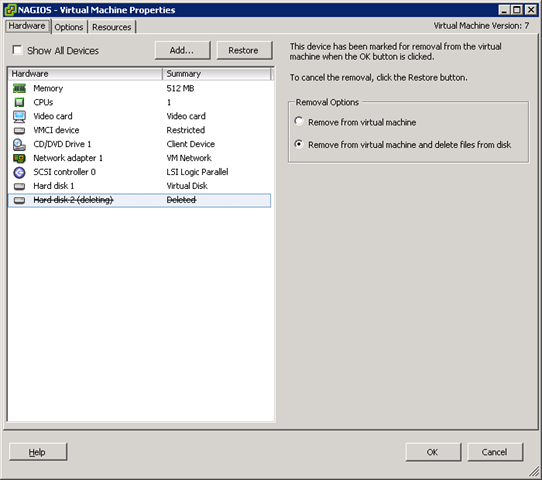
Now it’s time for an example. I have a VM called NAGIOS and needed to remove 512MB RAM and needed to add an extra vCPU. So I started the script with the following parameters:

.\Change-VM_Memory_CPU_Count.ps1 -vCenter vc01.ict-freak.local -vmName NAGIOS -MemoryMB 512 -MemoryOption Remove -CPUCount 1 -CPUOption Add

The VM is powered off and the memory is downgraded to 1024MB RAM and the total number of vCPU’s upgraded to 2.

image

You can download the script below.

Continue reading “PowerCLI: Script to Schedule Memory and or vCPU up/downgrade”

PowerCLI Schedule a restart job for one or multiple VM’s


I created the following script to schedule some restart jobs overnight. The goal for this script was to add some parameters so you don’t have to edit the script file itself to schedule it for another VM or a group of VM’s.

####################################################################
#
# Restart-VMs.ps1
# 
# -vCenter vCenter Server or Servers to connect to. 
# Example -vCenter "vc01","vc02"
# -vmName the VM or VMs to restart.
# Example -vmName "VM1" or -vmName "VM1","VM2"
# # Example: #.\Restart-VMs.ps1 -vCenter vc01.ict-freak.local -vmName "VM1","VM2" # # Version 1.0 May 2010 Arne Fokkema www.ict-freak.nl @afokkema # ##################################################################### param( [parameter(Mandatory = $true)] [string[]]$vCenter, [parameter(Mandatory = $true)] [string[]]$vmName ) $VIServer = Connect-VIServer $vCenter If ($VIServer.IsConnected -ne $true){ Write-Host "error connecting to $vCenter" -ForegroundColor Red exit } foreach($vm in $vmName){ Write-Host "Going to restart $vm" Restart-VMGuest -VM (Get-VM $vm) -Confirm:$false } Disconnect-VIServer -Confirm:$false

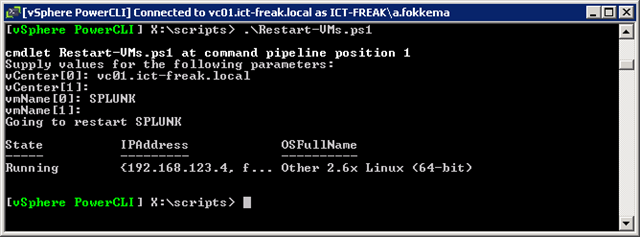
Let’s start to run the script from the PowerCLI console first:

image

I started the script without setting any of the parameters. Since these two parameters are necessary  to run the script, you will be asked to enter the parameters, before you can continue.


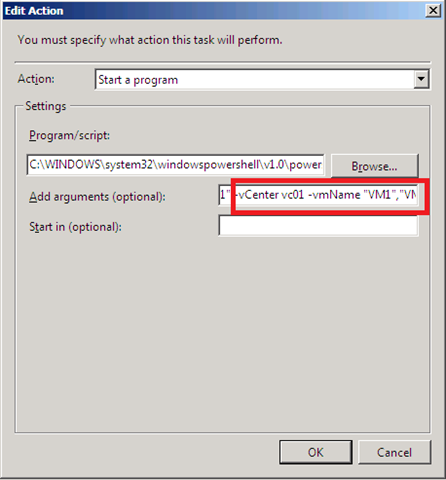
Now it’s time to schedule the script in Windows Server 2008. Just create a simple scheduled task with the following settings:

The first line below is the Program/script: setting. The second line is the Add arguments setting.

C:\WINDOWS\system32\windowspowershell\v1.0\powershell.exe

-PSConsoleFile "C:\Program Files (x86)\VMware\Infrastructure\vSphere PowerCLI\vim.psc1" " &  "C:\Scripts\Restart-VMs.ps1" -vCenter vc01 -vmName "VM1","VM2"

image

When you are going to use this script, be absolutely sure you are allowed to restart the VM’s you scheduled.

vSphere ISO containing Intel 82575 and 82576 Gigabit Ethernet Adapter drivers


This post is a complete re-post from Eric Sarakaitis blog: http://www.vmwareadmins.com


So, after spending three days on this, I was finally able to get the  Intel 82575 and 82576 Gigabit Ethernet Adapter driver slipstreamed onto the installation media.

I first followed this: http://patrickvanbeek.wordpress.com/2010/01/30/slipstreaming-drivers-in-the-esx4i-install-iso/ to get the post install drivers working.

But I still had the problem of not being able to see the NIC’s during the install.

to do that, I had to explode the ESX 4.0u1 ISO and grab the initrd.img file from the isolinux folder.

To do the modifications of the img file I needed a linux guest… so I fired up a Ubuntu image on Lab Manager and SCP’d the img file there.

To extract the IMG file do:

1.mkdir ~/tmp
2.cd ~/tmp
3.cp /boot/initrd.img ./initrd.gz
4.gunzip initrd.gz
5.mkdir tmp2
6.cd tmp2
7.cpio -id < ../initrd.img

now you should have a lot of files in ~/tmp/tmp2 directories, including a lot of subdirectories like sbin,lib

Now you need to extract the igb.xml and igb.o from the VMware RPM (http://www.vmware.com/support/vsphere4/doc/drivercd/esx40-net-igb_400.1.3.19.12-1.0.4.html.)

I then moved these files to their respective locations within the exploded initrd.

the igb.xml went into

1./usr/share/hwdata/pciids/

the igb.o went into

1./usr/lib/vmware/vmkmod/

then pack the files back into the archive using the following command

1.cd ~/tmp/tmp2
2.find . | cpio –create –format=’newc’ > ~/tmp/newinitrd
3.cd ~/tmp
4.gzip newinitrd

now you would have a newinitrd.gz
rename this now –
mv newinitrd.gz as newinitrd.img
this is the new boot image now !!

I then re-created the ISO. Oddly enough, it worked on the first try 🙂

and the link to the ISO… http://www.vmwareadmins.com

vSphere: Hot Add or Remove a VMDK with a Linux VM


In this post I will show you how to hot add a new VMDK to a Linux VM. I will also post how to remove a VMDK if necessary.


Hot Add a new VMDK

Add the new VMDK:

image

After you added the new VMDK login to the VM and run fdisk –l

[root@nagios ~]#  fdisk -l

Disk /dev/sda: 21.4 GB, 21474836480 bytes
255 heads, 63 sectors/track, 2610 cylinders
Units = cylinders of 16065 * 512 = 8225280 bytes

   Device Boot      Start         End      Blocks   Id  System
/dev/sda1   *           1          13      104391   83  Linux
/dev/sda2              14        2610    20860402+  8e  Linux LVM

The new disk isn’t available yet so we have to do a SCSI bus rescan. You can run the following command to do a rescan:

echo "- – -">/sys/class/scsi_host/host0/scan

When you run the fdisk –l command after the rescan, you will see the new disk.

[root@nagios ~]# fdisk -l

Disk /dev/sda: 21.4 GB, 21474836480 bytes
255 heads, 63 sectors/track, 2610 cylinders
Units = cylinders of 16065 * 512 = 8225280 bytes

   Device Boot      Start         End      Blocks   Id  System
/dev/sda1   *           1          13      104391   83  Linux
/dev/sda2              14        2610    20860402+  8e  Linux LVM

Disk /dev/sdb: 10.7 GB, 10737418240 bytes
255 heads, 63 sectors/track, 1305 cylinders
Units = cylinders of 16065 * 512 = 8225280 bytes

Disk /dev/sdb doesn’t contain a valid partition table

The new disk doesn’t contain a valid parition table. This can be fixed with running the fdisk /dev/sdb command:

fdisk –l /dev/sdb n p 1 1 {enter} x b 1 128 w q

The options x b 1 128 will align the new parition.  For more info about, see Bob Plankers his post here: http://lonesysadmin.net/2010/03/30/i-will-keep-saying-it-align-your-partitions/

Now we have a valid parition table but no file system. Run the mkfs.ext3 /dev/sdb1 command to accomplish this task:

[root@nagios ~]# mkfs.ext3 /dev/sdb1
mke2fs 1.39 (29-May-2006)
Filesystem label=
OS type: Linux
Block size=4096 (log=2)
Fragment size=4096 (log=2)
1310720 inodes, 2620595 blocks
131029 blocks (5.00%) reserved for the super user
First data block=0
Maximum filesystem blocks=2684354560
80 block groups
32768 blocks per group, 32768 fragments per group
16384 inodes per group
Superblock backups stored on blocks:
        32768, 98304, 163840, 229376, 294912, 819200, 884736, 1605632

Writing inode tables: done
Creating journal (32768 blocks): done
Writing superblocks and filesystem accounting information: done

This filesystem will be automatically checked every 39 mounts or
180 days, whichever comes first.  Use tune2fs -c or -i to override.

Run the fdisk –l command to verify the new configuration:

[root@nagios ~]# fdisk -l

Disk /dev/sda: 21.4 GB, 21474836480 bytes
255 heads, 63 sectors/track, 2610 cylinders
Units = cylinders of 16065 * 512 = 8225280 bytes

   Device Boot      Start         End      Blocks   Id  System
/dev/sda1   *           1          13      104391   83  Linux
/dev/sda2              14        2610    20860402+  8e  Linux LVM

Disk /dev/sdb: 10.7 GB, 10737418240 bytes
255 heads, 63 sectors/track, 1305 cylinders
Units = cylinders of 16065 * 512 = 8225280 bytes

   Device Boot      Start         End      Blocks   Id  System
/dev/sdb1               1        1305    10482381   83  Linux

if you want to auto mount the new disk, you have to create a new folder and add an entry to the /etc/fstab file.

mkdir /disk2
nano or vi /etc/fstab

add the following line:
/dev/sdb1               /disk2                  ext2    defaults        1 2

Now you are ready to mount the new disk.

mount /dev/sdb1 /disk2/

These are all the steps.

Hot Remove a VMDK

If you want to remove an extra VMDK from a Linux VM,you need to follow these steps.

First you need to unmount the /dev/sdb1:

umount /dev/sdb1

Remove the /disk2 folder:

rmdir /disk2/

Remove the entry from the /etc/fstab:

nano or vi /etc/fstab

remove the following line:
/dev/sdb1               /disk2                  ext2    defaults        1 2

Delete the device:

echo 1 > /sys/block/sdb1/device/delete

Remove the VMDK:

image

vSphere: Unattended ESX4 installation Tips & Tricks


In this post I will share some tips / tricks and scripts, which I used to create an unattended ESX4 installation.


One of the important lessons I have learned with creating a ks.cfg file for vSphere is how to use proper escaping.

for each $ in your script use a \ to escape it properly. See the example below:

VMHBA=\$(/usr/sbin/esxcfg-scsidevs -a |grep "Software iSCSI" |awk ‘{print \$1}’)

This form of escaping was necessary to get my script working. My script started with the following lines:

%post

cat > /root/esx01.sh <<EOF1

#!/bin/sh

and these are the last lines of the script:

##########################
# Finish
##########################
echo "Making sure the script runs only once"

EOF1

###Make esxcfg.sh eXcutable
chmod +x /root/esx01.sh

###Backup original rc.local file
cp /etc/rc.d/rc.local /etc/rc.d/rc.local.bak

###Make esx01.sh run from rc.local and make rc.local reset itself
cat >> /etc/rc.d/rc.local <<EOF
cd /tmp
/root/esx01.sh
mv -f /etc/rc.d/rc.local.bak /etc/rc.d/rc.local
shutdown -r now
EOF

The rest of this post, I will show you some tips about configuring Syslog, iSCSI, User creation, Change service console memory, Install Dell Open Manage agent, Set the host into maintenance mode.

But before I start with the tips mentioned above, I want to share a little trick a learned from  a comment from David on an excellent blog post by Robert Patton. In stead of using a long sleep at the beginning of your script, you can use the following tip:

hostd-vmdb

Before you start the post script, you have to wait until the hostd-vmdb service is ready. This is necessary  if you want to use the /usr/bin/vmware-vim-cmd command. With the following while loop, you can check the status of the hostd-vmdb service. When the service is ready, the script continues to configure your ESX server.

####################################################
#Wait until host service is ready
####################################################
while ! vmware-vim-cmd /hostsvc/runtimeinfo; do
sleep 20
done


I configured the Syslog settings at the beginning of my script, so I can monitor al the steps via the Syslog service:

Syslog

This is just an easy one. The only thing you have to do is echo the following lines:

####################################################
# Configure Syslog
####################################################
echo "# remote syslog server Splunk" >> /etc/syslog.conf
echo "*.* @192.168.123.219" >> /etc/syslog.conf
service syslog restart

The next tips is about the configuration of iSCSI.

Configure iSCSI

The following script part will add a new vSwitch1 called iSCSI and set the IP settings.

####################################################
# Add Storage Networking
####################################################
/usr/sbin/esxcfg-vswitch –add-pg="iSCSI" vSwitch1
/usr/sbin/esxcfg-vswitch –pg="iSCSI" -v 36 vSwitch1
/usr/sbin/esxcfg-vmknic -a -i 172.1.1.202 -n 255.255.255.0 "iSCSI"

/usr/sbin/esxcfg-route 192.168.123.254

# Refresh network settings
/usr/bin/vmware-vim-cmd internalsvc/refresh_network

The next step is to enable the iSCSI initiator and add a rule to the Firewall. After the 10 seconds sleep, the correct VMHBA will be selected for the rest of the steps. The VMHBA is saved in a variable which will be used to set the CHAP password, add the iSCSI Send Targets and perform a VMHBA rescan.

####################################################
# Configure iSCSI
####################################################
/usr/bin/vmware-vim-cmd hostsvc/firewall_enable_ruleset swISCSIClient
/usr/bin/vmware-vim-cmd hostsvc/storage/software_iscsi_enabled true

sleep 10

VMHBA=\$(/usr/sbin/esxcfg-scsidevs -a |grep "Software iSCSI" |awk ‘{print \$1}’)

# Set CHAP password
/usr/bin/vmware-vim-cmd hostsvc/storage/iscsi_enable_chap \$VMHBA iscsi_cluster_01 <chap_password>

# Add iSCSI Send Targets
/usr/bin/vmware-vim-cmd hostsvc/storage/iscsi_add_send_target \$VMHBA 172.1.1.10
/usr/bin/vmware-vim-cmd hostsvc/storage/iscsi_add_send_target \$VMHBA 172.1.1.11

sleep 15

/usr/sbin/esxcfg-rescan \$VMHBA

The rest of the vSwitches / Portgroups are left out of this post.


Add Users

If you want to add users with encrypted passwords, You can use the openssl passwd –1 command on
an existing ESX Server to generate a MD5 encrypted password.

image

This little trick can be used to generate the root password for ESX and to generate passwords for other users.

You can use the following line to set the root password during the installation:

# root Password
rootpw –iscrypted $1$EpQvSrYkznF6yCLKPQqZPUYr6z

and if you want to add more users to the Service console, you can use the following lines:

####################################################
# Add users
####################################################
/usr/sbin/useradd -p ‘\$1\$L4fGhr0F\$ImLwX47v3xZkAH4HrmBjr0′ -c "Arne Fokkema" afokkema

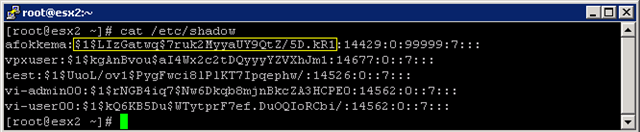
Instead of generating passwords, you can also use the string from the /etc/shadow file. You can open de file with cat and copy the string:
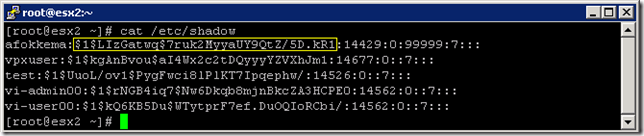
image


Change the vSwitch portnumber value to 120

To change the vSwitch portnumber to 120, you can use the following command:

####################################################
# Change the vSwitch portnumber to 120
####################################################
/usr/bin/vmware-vim-cmd  hostsvc/net/vswitch_setnumports vSwitch0 128

This will change the default setting to 120:
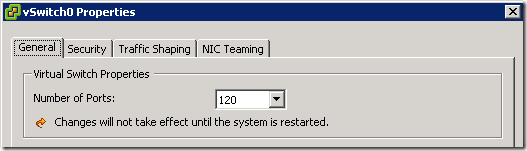
image


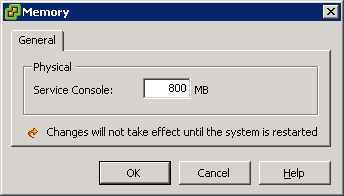
Change the Service Console Memory to 800MB

To change the Service Console memory to 800MB, you can use the following commands. These settings are applied after a reboot.

####################################################
# Configure Service Console Memory to 800MB
####################################################
/usr/bin/vmware-vim-cmd /hostsvc/memoryinfo 838860800
/usr/sbin/esxcfg-boot -b
/usr/sbin/esxcfg-boot -t

This is how it looks like in the vSphere client:

 image

Dell Open Manage Agent

The script below is a based on a script by Scot Hanson (aka @DellServerGeek) which you can find here.

This script will download the OM agent from an internal Webserver and opens the firewall for the Open Manage agent.

####################################################
# Dell OM Agent        
####################################################

mkdir -p /root/OM

#Download OM.tar.gz
esxcfg-firewall –allowOutgoing
lwp-download http://webserver/OM/OM.tar.gz /root/OM/.
esxcfg-firewall –blockOutgoing

cd /root/OM
tar -zxf OM.tar.gz
chmod a+x *.*

./linux/supportscripts/srvadmin-install.sh -x
#./linux/supportscripts/srvadmin-services.sh start

/usr/sbin/esxcfg-firewall -o 1311,tcp,in,OpenManageRequest

Enable vMotion

To enable vMotion, We use another variable to capture the right vmkernel portgroup:

####################################################
# Enable vMotion on the vMotion PG
####################################################

service mgmt-vmware restart
sleep 1m

VMK=\$(esxcfg-vmknic -l |grep vMotion |awk ‘{print \$1}’)
/usr/bin/vmware-vim-cmd hostsvc/vmotion/vnic_set \$VMK

# Refresh network settings
/usr/bin/vmware-vim-cmd internalsvc/refresh_network

Enter Maintenance mode

When the installation is ready, the ESX host will enter maintenance mode before it restarts to finalize the installation.

####################################################
# Enter Maintenance mode
####################################################
/usr/bin/vmware-vim-cmd /hostsvc/maintenance_mode_enter


It can cost you a lot of time to create a ks.cfg to match your vSphere environment. But when it’s ready, it will save you a lot of time deploying new hosts or redeploy other hosts.

If you have any additional scripts or tips please leave a comment or contact me on twitter: @afokkema


Sources:

vSphere: An error occurred, please try again in another vSphere session


image


From KB1014213:

When trying to update host data, you may experience these symptoms:
The vCenter Service Status shows the error:

An error occurred, please try again in another vSphere session.
The Hardware Status tab shows the error:

An error occurred, please try again in another vSphere session.

From: KB1013893

The VirtualCenter Server Service Status fails with the errors:

Cannot access the health service!

Login to the query service failed

Do not have permission for this command

The solutions mentioned in both the KB articles didn’t solve the issue for me. In my case name resolution was the problem. We use another domain for our vCenter server. The clients where not able to resolve the FQDN of the vCenter server. So I added the FQDN and ip address to the hosts file. After this little change and reconnecting the vSphere client, everything worked as it should be.

Release: PowerCLI Update Manager cmdlets


image

Just saw the news on Twitter. The PowerCLI Update Manager cmdlets are back!

Quote from the PowerCLI blog:

Cmdlet Name

Cmdlet Description

Attach-Baseline

Attaches baselines to the specified Template, VirtualMachine, VMHost, Cluster, Datacenter, Folder, and VApp objects.
Attaching a baseline to a container object such as a folder or datacenter transitively attaches the baseline to all objects in the container.

Detach-Baseline

Detaches baselines from the specified inventory objects.

Download-Patch

Downloads new patches into the Update Manager patch repository from the enabled patch download sources.

Get-Baseline

Retrieves the baselines specified by the provided cmdlet

parameters.

Get-Compliance

Retrieve baseline compliance data for the specified object of type Template, VirtualMachine, VMHost, Cluster, Datacenter, Folder, and VApp.

Get-Patch

Retrieves all available patches or those specified by the provided cmdlet parameters.

Get-PatchBaseline

Retrieves all patch baselines or those specified by the provided cmdlet parameters.

New-PatchBaseline

Creates a new patch baseline. Patch baselines can be applied to either hosts or virtual machines. Depending on the patch criteria you select, patch baselines can be either dynamic or static (fixed).

Remediate-Inventory

Remediates an inventory object against the specified baselines.

Remove-Baseline

Deletes the specified baselines from their servers. Before the

removal, the baselines are detached from all entities they have been attached to.

Scan-Inventory

Scans inventory objects for baselines attached to them.

Set-PatchBaseline

Modifies the properties of a patch baseline. You can specify explicitly the patches you want to include in the baseline through the IncludePatch parameter.

Stage-Patch

Initializes staging of patches. Staging allows you to download

patches from the Update Manager server to the ESX/ESXi hosts, without applying the patches immediately.


Download and more information can be found here: http://communities.vmware.com/

Release Notes can be found here: http://communities.vmware.com/docs/DOC-12075

The online manual can be found here: http://www.vmware.com/


You need to install PowerCLI 4 update 1 before you install the Update Manager cmdlets

An important vSphere 4 storage bug is solved in patch ESX400-200912401-BG


image

Chad Sakac over at http://virtualgeek.typepad.com already blogged about the APD bug in December last year. You can find his post here. 

Just a short quote from Chad his post about the symptoms of this APD bug:

Recently saw a little uptick (still a small number) in customers running into a specific issue – and I wanted to share the symptom and resolution.   Common behavior:

  1. They want to remove a LUN from a vSphere 4 cluster
  2. They move or Storage vMotion the VMs off the datastore who is being removed (otherwise, the VMs would hard crash if you just yank out the datastore)
  3. After removing the LUN, VMs on OTHER datastores would become unavailable (not crashing, but becoming periodically unavailable on the network)
  4. the ESX logs would show a series of errors starting with “NMP”

Examples of the error messages include:

    “NMP: nmp_DeviceAttemptFailover: Retry world failover device "naa._______________" – failed to issue command due to Not found (APD)”

    “NMP: nmp_DeviceUpdatePathStates: Activated path "NULL" for NMP device "naa.__________________".

What a weird one…   I also found that this was affecting multiple storage vendors (suggesting an ESX-side issue).  You can see the VMTN thread on this here.


We found out about this issue during a big storage project. We where creating a lot of new LUNs and where removing a lot of the old LUNs. If you remove a LUN on a way not mentioned in Chad his post:

This workaround falls under “operational excellence”.   The sequence of operations here is important – the issue only occurs if the LUN is removed while the datastore and disk device are expected by the ESX host.   The correct sequence for removing a LUN backing a datastore.

  1. In the vSphere client, vacate the VMs from the datastore being removed (migrate or Storage vMotion)
  2. In the vSphere client, remove the Datastore
  3. In the vSphere client, remove the storage device
  4. Only then, in your array management tool remove the LUN from the host.
  5. In the vSphere client, rescan the bus.

So when we used the workaround described above, everything went fine. But at my current employer, we use a large LeftHand iSCSI SAN.  One of the great things of Lefthand SAN is the ability to move LUNs between different clusters. With the APD bug, we couldn’t use this option anymore.

When we discovered this APD bug we contacted VMware Support. After a couple of weeks we received an e-mail with the following fix.

I can now confirm that the APD (All paths dead) issue has been resolved by a patch released as part of P03.

To install this patch, please upgrade your hosts to vSphere Update 1 and use Update Manager to install the latest patches.

Please ensure that ESX400-200912401-BG is installed as this resolves the APD problem

We upgraded one of our clusters to Update 1 and installed the latest patches including the ESX400-200912401-BG patch. After installing the patch, we did some tests and I can confirm that the APD bug is history!!

To reproduce this issue I created two iSCSI LUNs on the EMC VSA. Instead of removing the LUNs I disconnected the iSCSI network to simulate this. So before I disconnected the iSCSI network, all LUNs are working just fine:

image

After I disconnected the iSCSI network and waited a while, all the paths to the EMC LUNs are dead and they are colored red:

image

This is just normal behavior but before installing the ESX400-200912401-BG patch, the ESX host will stall for 30 till 60 seconds. This means that all the VMs running on a host of which a LUN was disconnected will stall, even though the VM is on a different datastore!! I am happy that VMware has solved this APD bug.


If you want to make sure if you already installed the APD patch, you can easily verify this with the vCenter Update Manager.

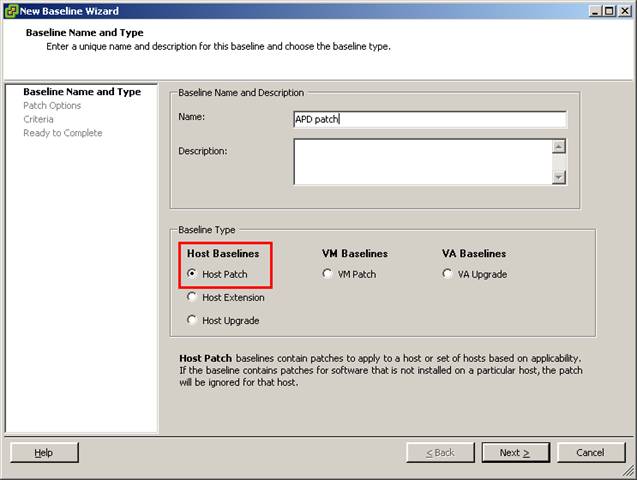
Go to the tab Update Manager and open the Admin View. Add a new baseline. Select the Host Patch option:

image

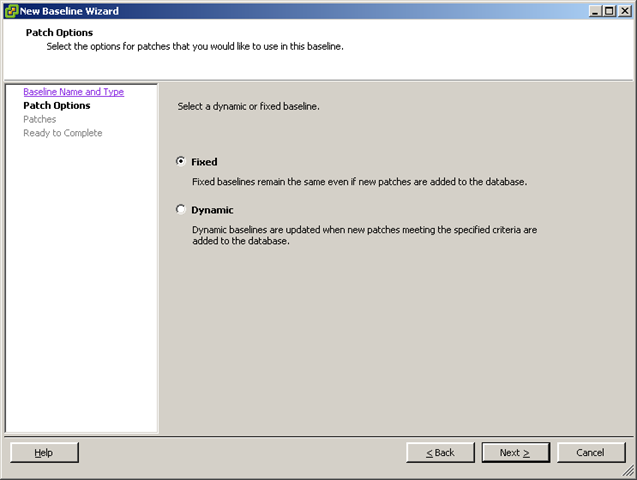
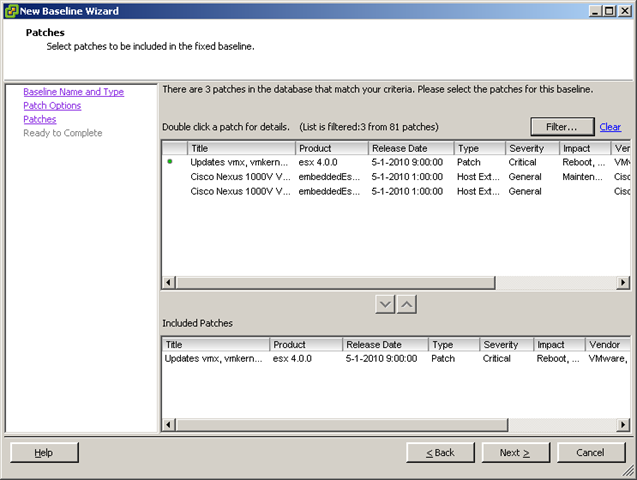
In the next screen select Fixed:

image 

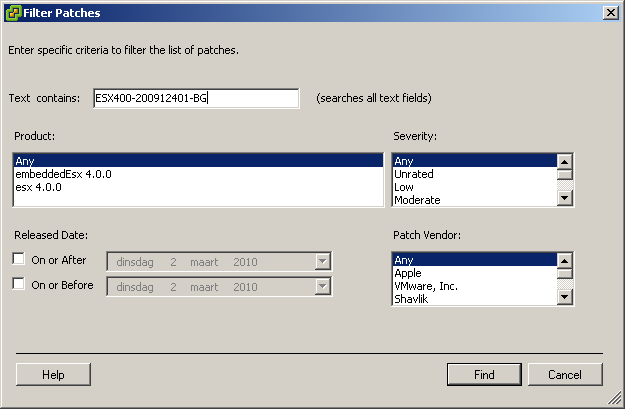
Now we are going to create a filter. Enter the name of the patch:

image

Select the ESX400-200912401-BG patch:

image

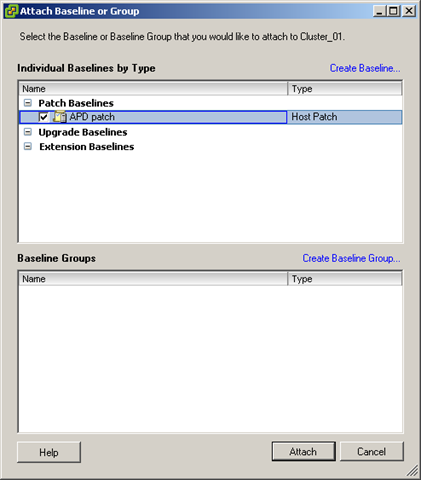
When the new baseline is ready, return to the Compliance view and attach the new baseline:

image

The final step is to perform a scan on your Datacenter, Cluster or ESX Host. Now wait and see if the patch is already installed or not.


More info about the patch can be found here:

For the readers who cannot upgrade to vSphere Update 1 and the latest patches, you can find some workarounds here:

PowerCLI: Return Datastore name by Canonical name


When you are troubleshooting an ESX host, you can see a lot off warnings in the VMKERNEL log:

Jan 29 16:15:34 esx02.ict-freak.local vmkernel: 9:23:45:33.917 cpu1:4210)WARNING: NMP: nmp_DeviceAttemptFailover:
Retry world failover device “t10.9454450000000000000000001000000056900000D0000000” – issuing command 0x4100041f0c00

But which datastore belongs to the Canonical name mentioned in the VMKERNEL log??

The following script will return the Datastore name. Thanks @Lucd22 for the help!!

$esxhost = "esx1.ict-freak.local"
$id = "t10.9454450000000000000000001000000056900000D0000000"

foreach($ds in (Get-VMHost $esxhost | `
    Get-Datastore | where{$_.Type -eq "vmfs"} | Get-View)){

    $ds.Info.Vmfs.Extent | %{
         if($_.DiskName -eq $id){
            Write-Host $ds.Info.Name $_.DiskName
        }
    }
}

The output will look like this:

image

Ok, this is a nice script to have in you toolbox, but I hear you think,  how do I add it to the VESI?.

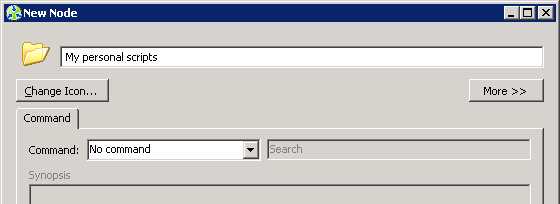
First you need to create a new folder, if you don’t use any other Powerpack.

image

Give the folder a name. I used the name Personal scripts:

image

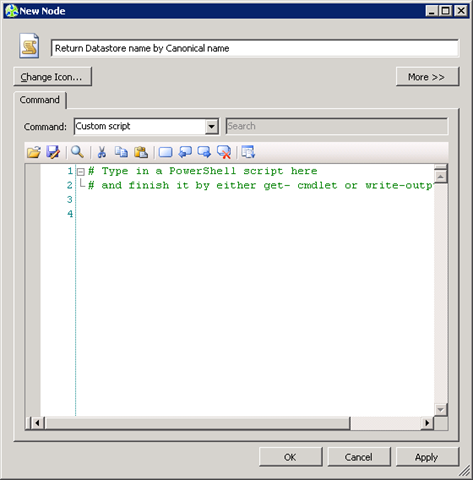
The next step is to add a new script node:

image

The last step is to paste the following code into the new created script node:

if ($global:defaultviservers) {
    $id = Read-Host "Enter the Canonical Name (naa.xxxxxxxxxxxxxxxxxxxxxxxxxxxxxxx)"
    foreach($esx in (Get-VMHost)){
        foreach($ds in (Get-VMHost $esx | Get-Datastore | ` 
        where{$_.Type -eq "vmfs"} | Get-View)){
            $Details = "" |Select-Object DataStore
                $ds.Info.Vmfs.Extent | %{
                 if($_.DiskName -eq $id){
                    $Details.DataStore = $ds.Info.Name
                }
               }
        }
        $Details.PSTypeNames.Clear()
        $Details
    }
}
Else {
    [System.Windows.Forms.MessageBox]::Show('You must connect to one or more hosts before you can use this node. Please click on the ''Managed Hosts'' node of the VMware PowerPack, connect to one or more of the servers you have configured there, and then try again.','Connection not established',[System.Windows.Forms.MessageBoxButtons]::OK,[System.Windows.Forms.MessageBoxIcon]::Information) | Out-Null
}

If you want to run this script, you have to connect to vCenter first. Open VMware – Managed Hosts:

image

Click on Add managed host… to add a server:

image

To connect to the new added vCenter server, press the connect under actions. To run the script click on the new create script node and enter a Canonical Name.

image

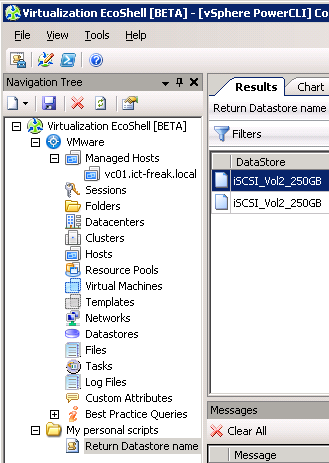
And the script will return the Datastore name:

image

Now you are able to convert the Canonical name to the Datastore Name.